UW–Madison is a campus-wide member of the Career Leadership Collective (commonly referred to as The Collective), an organization focused on helping higher education institutions better connect career development to the full student experience.
To give you a clearer sense of what that means—and how you can take advantage of the membership—Danielle Marriner spoke with Nick Cattin, Senior Manager of Consulting & Training at The Collective, about their approach, key trends in the field of career services, and ways staff can get involved.
—
Danielle: For those who may be less familiar, how would you describe The Career Leadership Collective—and what makes it different from organizations like NACE?
Nick: The Career Leadership Collective is a consulting and training organization that helps campus leadership, career teams, and individuals weave career success into the campus ecosystem, ensuring all students experience career success. Our entire team are higher education insiders, having formerly led career development efforts at a variety of institutional types, including Indiana University, Colorado State, Miami University (OH), Dennison, and Michigan Tech, just to name a few.
NACE is a strong advocate for our field in providing conferences and professional development. We focus more on strategic solutions through consulting, training, and leadership development for campuses, empowering teams and individuals to be strategic in their work.
Danielle: A lot of your work is built around a “career ecosystem” model. Can you briefly explain what that means and how it shapes the way institutions approach career development?
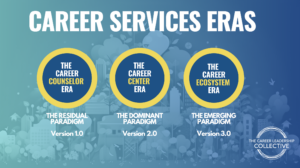
Nick: The career ecosystem model is based on our consulting framework book, The Career Ecosystem Era in Higher Education. Historically, career services has been an opt-in model for students, or “come see us.” Yet often, students who opt-in are the least likely to need assistance. Even if some do, that model tends to let too many students fall through the cracks.
A career ecosystem helps move career success beyond the walls of an office and into the student experience, within the curriculum and co-curriculum. This shifts from an “opt-in” model towards “opt-out”, if not required, creating an environment where career success becomes unavoidable for all students, regardless of chosen major, background, or lived experience.
This means we may shift away from standalone workshops or service overviews within a classroom to building tailored engagements that are embedded within the student experience. It also means making career success more accessible through asynchronous options for students. Does this mean one-on-one advising goes away? Not at all. Instead, it engages more students in career success overall, increasing the likelihood that we get connected with students who need the most assistance in one-on-one or smaller curated experiences. For a summary of those insights, our blogs on “The Emerging Paradigm in College Career Services” and “The Four Foundations of the Career Ecosystem Era“ are a great place to start.
Danielle: For career services professionals across the spectrum—from new staff to experienced leaders—what are some practical ways they can engage with and benefit from The Collective?
Nick: As mentioned above, we have a number of resources available to campuses, such as the blogs we publish, which are a great place to learn about trends regardless of your role or level. We also host The Career Ecosystem Era in Higher Education Podcast, where our team discusses key elements of building a career ecosystem, and we also interview university leaders, faculty, and career leaders actively embedding career success to create their career ecosystems.
Additionally, UW-Madison is a campus-wide member of The Collective. That means anyone who works for UW-Madison can access member-only resources, such as our career ecosystem resources portal, member Toolkits, our upcoming members-only virtual trends session (August 7 at 12:00 p.m. EDT, registration opening soon), a reading and discussion guide for our book, and discounts for our training sessions (Think Tanks, conferences, and leadership cohort programs: Mastermind, Aspire, and Kickstart).
UW–Madison employees can create an account and access member-only content. To do so, click “Log in/Sign up” on the Member Log-in webpage, and then click “New to site, Sign-up.” Make sure to include your first and last name, and your wisc.edu email address.
Danielle: What trends are you seeing across career services and higher education right now, and how is your team helping institutions respond to those changes?
Nick: A few trends that we are both seeing and helping campuses with include:
- Defining your specific Career Learning Outcomes (CLOs). These are not career team CLOs, but are either academic college-wide or university-wide. Career Learning Outcomes help establish, “What are we trying to help students learn, not just now, but throughout their careers?” This is also a shift away from a focus on a tactic, like having a resume, towards higher-level learning, such as “curating your story and artifacts connected to your professional goals.”
- Curricular and co-curricular integrations. Where can we embed career success within these two areas of the student experience, ensuring students get the career development they need? Some campuses are doing this within the general education requirements, but others are using a multi-pronged strategy, such as in First-Year Seminars, student employment, and asynchronous learning modules embedded in classes and other experiences.
- Empowering faculty and other staff. As a field, we don’t need faculty or non-career staff to review resumes, but we do need them to assist in key areas. You don’t need hundreds of faculty and staff, but a few key ones who are bought into the work of career success.
- Connecting to the story of ROI (return on investment). At times, career success can still be seen as an add-on. Yet, it is critical to the mission of higher education. How colleges and universities talk about and deliver career success directly impacts enrollment, persistence, retention, graduation, and alumni affinity. As a field, we can do a better job connecting our work to those outcomes and telling that story more effectively.
We assist colleges and universities with the above trends by highlighting the great work others are doing through our resources, including our upcoming Think Tank series, and by providing plenary and design sessions for campuses.
Danielle: If there’s one reason a UW–Madison staff member should start engaging with The Career Leadership Collective now, what would that be?
Nick: Now is a great time for staff members to engage with The Collective to consider how to holistically bring career learning to all students in their respective schools and colleges. This is timely given prospective and current students’ desire to achieve career success. Additionally, you can showcase the ROI your role and team make for the school/college and university.
We offer practical advice through the aforementioned blogs and resources, and opportunities to level up your leadership to increase your and your team’s impact.
Danielle: Thanks, Nick!
—
As career development continues to evolve, the Career Leadership Collective provides a useful lens and set of tools for thinking differently about how we reach and support students. From big-picture strategy to small, practical ideas, their resources can help us build stronger connections across campus and expand the impact of our work.
“The Collective’s resources gave our team the structure to align around a broader, ecosystem approach to our work,” said Michelle Jackson, Director of the Career Exploration Center. “That shared shift in thinking is already helping us serve students more intentionally and effectively. Personally, I’ve found their conferences and leadership training to be some of the most valuable growth opportunities—connecting with peers across the country tackling similar challenges is both motivating and immediately applicable to our work.”
With our campus membership, these resources are already within reach—making it easy to explore, experiment, and bring new ideas into your work. Get started today!