Interviews are part of nearly every hiring process. They’re a chance for a candidate to build on the skills they showcased on the resume and cover letter, translate their experience to the current role, and give employers a taste of their personality. For a lot of people—especially students—they bring up a lot of anxiety.
“Interviews are similar to performances or public speaking, which can really spark anxiety. That’s where practicing, understanding the role, incorporating feedback, and practicing some more can improve confidence and (hopefully) result in a job offer,” said Ilsa May, Assistant Director for Career Services Technology in the Office of Academic and Career Success (OACS).
“You wouldn’t show up to a band performance without practicing,” she added. “So why would you show up to an interview without preparing?”
For UW–Madison students and alumni, there’s one tool that can make a world of difference when doing the prep work: Big Interview.
Big Interview is a job training tool focused on helping applicants build confidence and skill when interviewing. And it’s free to all UW–Madison students, employees, and alumni (with a NetID)!
What it offers
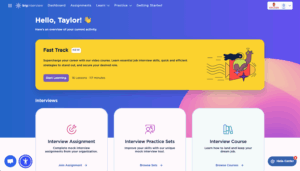
One of the best parts of Big Interview is that it has pre-packaged practice sets for students based on the industry they’re interested in. The tool allows students to review common questions, get advice on what to include in their answer, build out a possible response, and record themselves practicing answering the questions. Then they’ll get AI-generated feedback on their responses.
“I was really surprised how many different industries or post-graduation career path interview practice sets are available—from business to government to graduate school interviews,” said May.
The opportunity to get immediate feedback on a response—and then practice it again—can have a huge impact on a student’s preparation. And since many first-round interviews are now conducted virtually or via a recorded platform like HireVue, it’s a great way for students to get comfortable answering questions without relying on in-the-moment verbal or nonverbal feedback.
“The biggest hurdle for students preparing for an interview is simply getting those initial words out,” said Hannah Hatlan-Atwell, a career advisor in the School of Human Ecology. “Big Interview forces students to do that and review their responses to then improve the content, delivery, and non-verbals.”
The tool also has content on searching for a job, networking, negotiating an offer, and what to do during the first 90 days in a position, so there really is something in there for everyone.
How career advisors can use the tool
If you’ve never used Big Interview, start by logging in and seeing what’s available. Every UW–Madison employee can log in for free.
“Promote, promote, promote!” said May. “Many students don’t know about Big Interview unless they have taken a course that incorporates lessons or interview assignments.” Here are a few ways she suggests using the tool with your students.
- Promote practice sets Career advisors can select lessons or interview practice sets related to common career paths for your students and then place those direct links on websites or newsletters. It’s a great way to distill helpful features in the tool.
- Offer feedback Big Interview allows users to share recorded interviews with anyone to receive feedback, whether that’s a career advisor, mentor, alum, or friend. There are many possibilities to engage students in practicing and giving feedback.
- Create assignments Another collaborative option is utilizing the assignment feature within Big Interview, which allows org admin users to create custom interview assignments, review the recorded submissions, and provide ratings and feedback. Several units on campus incorporate Big Interview assignments into career or internship courses or collaborate with faculty to infuse career development into the academic curriculum.
“I can also see engaging alumni mentors to provide asynchronous, industry-specific feedback to students, which removes the barrier of coordinating schedules,” said May.
Anything you can do is going to help students get more engaged with the tool and start using it for themselves. And the good news is that when students use it, they like it. Your job is just to get them started.
“Recently, a journalism faculty member I work with incorporated Big Interview as a class assignment in an undergraduate course,” said Darby Winchel, Career and Internship Specialist with SuccessWorks and Communication Arts. “Many students weren’t aware of the resource and had great things to say about it!”
Resources to get started