
Internships and other experiential learning opportunities are a critical part of many students’ education at UW–Madison. They are a chance for students to apply what they’re learning in the classroom, gain new skills, build connections, and much more.
However, in the past, some students have reported instances where harassment occurred in internship settings. This was at the forefront of Danielle Marriner’s mind when she attended a conference session in 2023 where Kaila Bingen from UW–Parkside presented an experiential learning training module.
“We immediately recognized it as an essential training for our students,” said Marriner.
Marriner coordinated bringing the project to UW–Madison in partnership with the Morgridge Center for Public Service and the Student Employment team within the Office of Student Financial Aid. And it finally launched last spring—with huge success!
Over the summer, more than 550 students completed the Safety and Empowerment training, and a few shared feedback: “I appreciated learning about the rights of employees in the workplace, how discrimination can appear in different forms, and how to recognize warning signs of inappropriate behavior,” wrote one student on a discussion post for their School of Human Ecology internship course.
Career and internship courses, like the one this student was enrolled in, are a huge part of the training’s success. Many instructors are embedding it directly into career course assignments. However, not all students will take a career or internship course, so it’s important to reach students in other ways. Marriner recommends that all career services units link the training as a resource on their website.
Course content
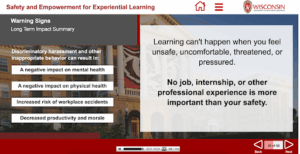
One of the main goals of the training is to make students feel empowered to speak up for themselves—especially in unfamiliar or uncomfortable situations.
“Experiential learning often introduces a lot of ‘newness’—new environments, people, systems, schedules, and cultures,” said Marriner. “This training helps students build confidence and awareness, and ideally makes them feel more comfortable navigating unfamiliar experiences.”
It also teaches students about the rights they have in experiential learning situations.
“The content provided in the Safety and Empowerment training is vital to our students’ success in internships,” said Sarah Fox, Internship & Employer Relations Manager in SoHE. “They are learning how to advocate for themselves in uncomfortable situations and are learning what steps to take if they encounter inappropriate behavior. I am also glad that this training dives deeper into the true definition of inappropriate behavior in the workplace.”
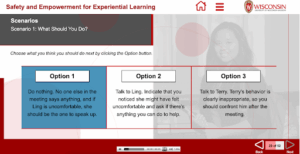
The training course utilizes interactive, real-life scenarios to introduce many of the concepts to students. And it even gives them the opportunity to practice using the skills they’ve learned to advocate for themselves.
What’s next?
Marriner hopes to collaborate more closely with faculty to continue to embed the course into additional career courses. But she also hopes to use the training as a jumping-off point to build a campus-wide culture around student empowerment in experiential learning settings.
“I’d love for us to integrate the messaging from the course into broader career readiness conversations,” said Marriner.
Anyone with a NetID can self-enroll in the training, and Marriner suggests that staff take it to learn how to better coach students through tough scenarios or inform employer partnerships.
“Our goal is to create safe, respectful, and empowering experiences for our students,” said Marriner. “This course is a great tool to move us in that direction.”